
Reviewed · PETRA TOURS
Petra Back-Road Trail and Hike
Petra rewards the feet that take the back way. This full-day hike begins at Little Petra, follows the dramatic Siq Ghorab canyon, and reaches Petra’s massive Monastery before continuing through the ancient city. I like the quiet approach and the way the Treasury arrives late in the day, after the scenery and ruins have already built anticipation. My main caution is simple: this is a long, demanding outing, not a gentle sightseeing walk.
I also like the small-group setup, with up to six people, and the chance to start with either pickup or a meeting at Little Petra. At $380 per group, the price is fair for six people, about $63 each, but much less attractive for one or two. The guide matters greatly here, and the mixed score of 4.2 from five ratings suggests that the quality of the guiding may not be perfectly consistent.
In This Review
- Key points before you book
- Why the back route changes your Petra day
- Little Petra and Beidha: a calm opening
- Siq Ghorab and the mountain route
- The Monastery after more than 800 steps
- Qasr Al-Bint and the Colonnaded Street
- The Street of Facades and the Royal Tombs
- The Treasury as the day’s final reward
- Nymphaeum and the Byzantine Church
- Price, group size, and guide quality
- Who should choose this hike?
- Should you book the Petra Back-Road Trail?
- FAQ
- What time does the Petra back-road hike start?
- Where does the experience begin?
- How long does the tour last?
- How many people can join the group?
- Is this hike physically demanding?
- What happens if bad weather cancels the tour?
Key points before you book
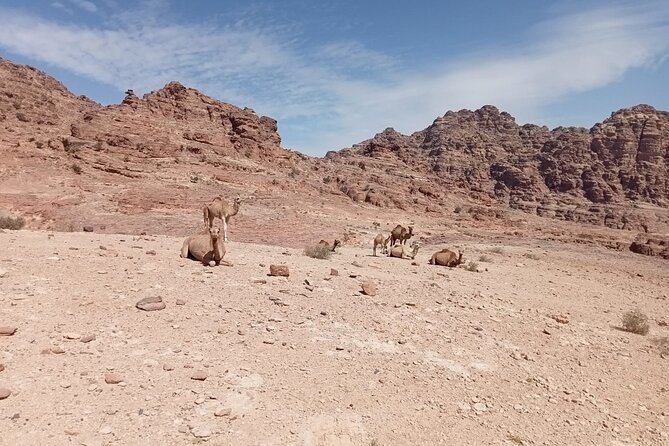
- Back-door arrival: You enter Petra through Little Petra and the Siq Ghorab route rather than beginning at the usual visitor center entrance.
- Big hiking day: Allow 8 to 9 hours, with a moderate fitness level required and more than 800 steps on the approach to the Monastery.
- Best dramatic moment: The Monastery appears after the mountain hike, then the route continues toward the Treasury as a grand finale.
- Small private group: The experience accepts a maximum of six people, making it easier to keep a steady walking pace and ask questions.
- Wide views: The route includes a panoramic lookout toward Wadi Araba and the mountains west of Petra.
- Flexible starting point: Pickup is offered, or you can meet the guide at Little Petra at 9:00 a.m.
Why the back route changes your Petra day
Most people experience Petra from the main visitor center, walking through the famous Siq toward the Treasury. This tour reverses the order. You begin in the countryside around Little Petra, cross mountain country, reach the Monastery first, and only later work your way through the central ruins toward Al Khazna, the Treasury.
That change has real value. The Treasury is Petra’s most famous facade, so seeing it immediately can make the rest of the site feel like an anticlimax. Here, the day builds slowly. You first see small rock-cut rooms, old settlement remains, narrow canyons, and high mountain views. Then the Monastery appears as the first great monument. The Treasury comes later, near the end, when you have a better sense of the scale of Petra.
You should also understand the trade-off. The back route is not a shortcut. It is a full-day hike with uneven ground, a long walk, and a major staircase to the Monastery. If you want a quick look at the Treasury and a few nearby tombs, this is the wrong format. If you want Petra as a journey through the hills, it makes much more sense.
The start time is 9:00 a.m. Pickup is available, though the exact pickup arrangement is not specified. You may also meet the group at Little Petra. Ask for clear instructions before the day begins, especially if you are arranging your own transport.
More Petra trips:
- Amman: Petra, Wadi Rum, and Dead Sea 2-Day Tour
★ 4.9 · 1,173 reviews - 2-Day Tour: Petra, Wadi Rum, and Dead Sea from Amman
★ 5.0 · 1,141 reviews - From Amman: Petra & Wadi Rum Private or group Day Tour
★ 4.9 · 750 reviews
Little Petra and Beidha: a calm opening
The first stop is Al-Beidha, better known as Little Petra or Siq al-Barid. The name refers to the cool canyon, and the setting is immediately different from the main Petra route. The passage is shorter and narrower than Petra’s famous Siq, with occasional wider pockets and rock-cut temples along the walls.
This is a good place to begin because it gives you time to get comfortable with the guide and the pace. You can examine old temples and painted houses before the longer walk begins. The remains are not as grand as the Treasury or Monastery, but they help you notice how the Nabataeans used the stone around them.
The tour also includes the Neolithic village of Beidha, one of Jordan’s oldest settlements. Seasonal communities of hunters and gatherers lived here during the Neolithic period. That early settlement gives the day a wider time scale. Petra is not only a Nabataean city carved into cliffs. People used this area long before the famous facades were made.
The Little Petra portion lasts about 2 hours and 30 minutes. That is a generous opening segment, so do not expect to reach the Monastery quickly. The time includes the Little Petra area and Beidha before the main hike takes over.
Admission is listed as included for this stop. You should still confirm exactly what is covered if you are arranging entry to the wider Petra site separately.
Siq Ghorab and the mountain route
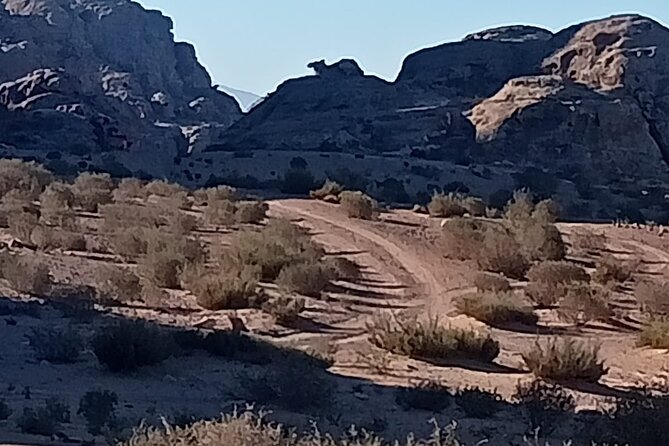
From Little Petra, the route continues through mountain scenery toward the old village and a place called Shamasah. Access comes through the large Siq Ghorab canyon. This is the part that gives the tour its character.
The attraction here is not one famous building. It is the gradual change from a small canyon site to a broad mountain route, with rock walls, open views, and remains of earlier settlement. You get a sense of Petra as a place connected by ridges, valleys, and passages, not just a row of monuments beside a road.
The old village contains remains of people who lived in the area thousands of years ago. The information provided does not give a precise date or a detailed list of structures, so you should expect the guide to explain what can be identified on the ground. This is one reason the quality of the guide matters. Without clear explanation, some of the less obvious remains may look like piles of stone.
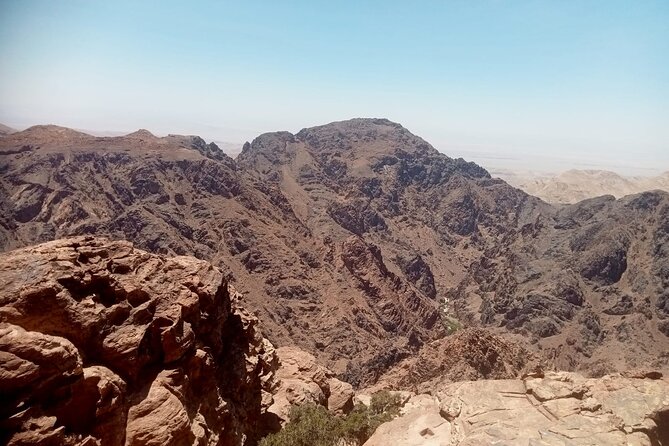
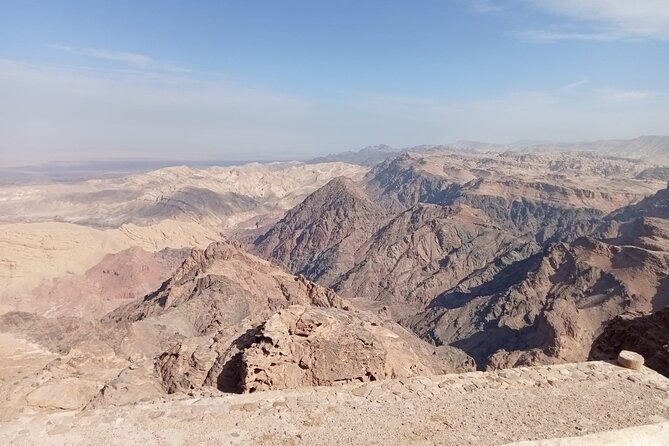
The best stated viewpoint comes near Shamasah, with a panorama toward Wadi Araba and the mountains on the western side. Bring your camera, but do not let the view turn into a rushed photo stop. The wide setting is one of the strongest reasons to choose this route over a standard entrance walk.
Because the tour requires moderate fitness, wear shoes suited to rocky paths and allow plenty of water. The description does not provide a detailed packing list, so plan for a long day outside and changing exposure between canyon shade and open mountain paths.
The Monastery after more than 800 steps
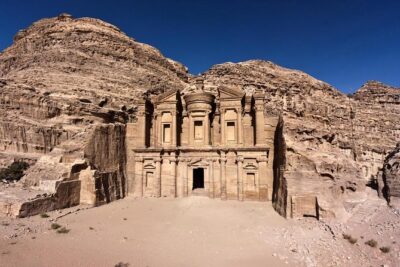
The Monastery, or Al Dayr, is the major reward of the uphill section. It is one of Petra’s largest monuments, about 47 meters wide and 48.3 meters high according to the tour description. Other stated measurements give it as roughly 50 meters wide and 45 meters high. Either way, it is enormous.
The facade was built in the style of the Treasury, though the Monastery is larger and less delicate in appearance. It was probably constructed as a Nabataean tomb in the third century BCE. Its modern name comes from crosses carved inside, suggesting that Byzantine Christians later used the space as a church.
The final approach follows an ancient rock-cut path with more than 800 steps from the Basin Restaurant area. On this tour, you reach the monument from the back route, but the staircase remains an important part of the day. This is where tired legs can change your opinion of the experience.
Take the steps steadily. The point is not to race upward. The Monastery is best appreciated when you give yourself time to look at the carved walls and the changing views rather than treating the staircase as an obstacle to defeat.
About two hours are allotted to the Monastery. That should give you time to examine the facade, recover from the climb, and take in the setting. Admission is listed as included for this stop.
A practical point: do not confuse the Monastery with a functioning religious building. It is an ancient monument, and the crosses relate to later Byzantine use. The building itself is a powerful example of Nabataean stone carving and design.
More Hiking Tours in Petra:
- Dana to Petra Trek + Wadi Rum & the Dead Sea – 9 Days
★ 5.0 · 165 reviews - From Amman: Wadi Mujib Siq Trail Private Hiking Tour
★ 4.9 · 36 reviews - Petra to Wadi Rum Trek – 6 Days
★ 5.0 · 11 reviews - Jordan Trail: Dana to Petra 4-Day Trekking Tour
★ 4.4 · 7 reviews
Qasr Al-Bint and the Colonnaded Street
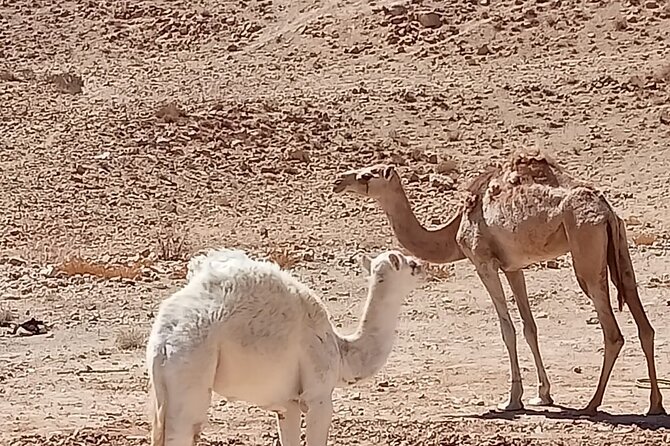
After the Monastery, the route enters the main old city of Petra. The Colonnaded Street is a useful change of mood. Instead of a single facade cut into a cliff, you see the remains of a planned urban center.
The street was originally Nabataean and later restored during the Roman period. The route description gives its width as about six meters after restoration in 106 BC. At its end is the triple gate leading toward Qasr Al-Bint, an important shrine.
The street once had buildings one or two stories high, though much of what you see now is fragmentary. That can be hard to picture without guidance. Look for the line of the street and the surviving architectural pieces, then imagine the space as a working city rather than an isolated archaeological park.
This section receives about one hour. That is enough for a purposeful look, but not a specialist archaeological study. The Colonnaded Street is included in the route, and the tour description lists admission as included for this stop.
The Street of Facades and the Royal Tombs

The Street of Facades contains several tombs cut into the rock. Tomb 67 receives special attention because its upper level includes a funeral chamber. Unlike some of Petra’s more difficult-to-reach tombs, these facades are relatively easy to examine from the route.
You get about 30 minutes here. That is a short stop, so focus on the carved fronts and the visible chambers rather than trying to inspect every detail. The facades are close together, which makes this a useful place to compare differences in shape, size, and decoration.
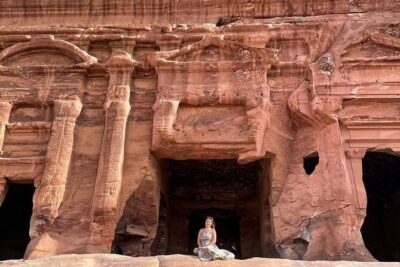
The Royal Tombs rise above the center of Petra on the western slope of Jabal al-Khubtha. This group includes the Urn Tomb, Silk Tomb, Palace Tomb, Corinthian Tomb, and the Tomb of Sesto Fiorentino.
To reach the Royal Tombs, you climb a staircase to the Urn Tomb. During the Byzantine period, it served as a place of worship. The nearby Silk Tomb takes its name from the strong shades in its sandstone, while the Palace and Corinthian Tombs are larger and more imposing.
The schedule allows about one hour for the Royal Tombs, but admission is listed as not included. That detail matters. Confirm the entry arrangements and budget before you book, since other stops are marked as included. The route description does not explain the difference in admission treatment.
The Treasury as the day’s final reward
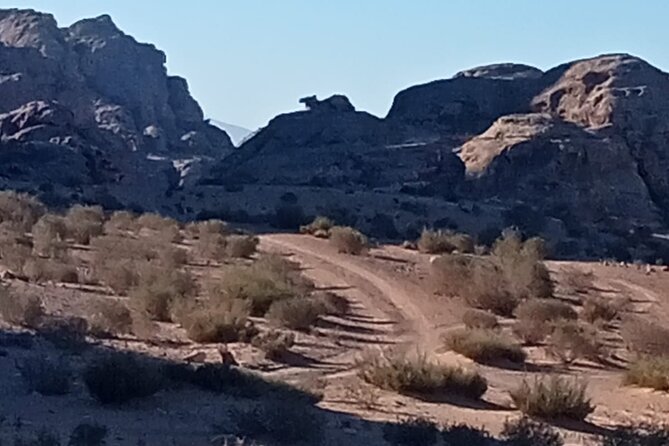
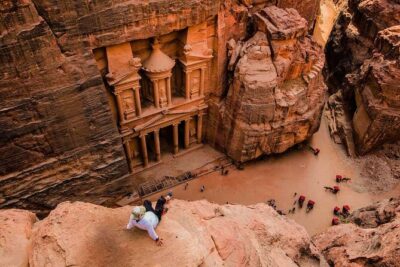
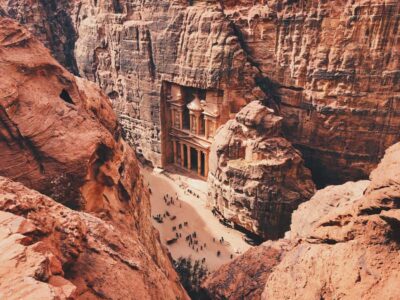
Al Khazna, the Treasury, is about 40 meters high and richly carved with columns, capitals, friezes, and figures. Its facade has two levels and three chambers. The central urn at the top inspired the local story that a pharaoh’s treasure was hidden inside, though the urn is understood as a royal memorial rather than a container of treasure.
The original purpose of the building remains uncertain, though it was likely made in the first century BC. That uncertainty is worth remembering. Petra’s monuments often carry famous names that came later, and the modern label does not always tell you exactly how a building was used.
The tour allows about 1 hour and 30 minutes at the Treasury. That is generous compared with many quick visits. You can take in the facade, listen to the explanation, and appreciate the way the monument comes into view after the long approach.
This is the point most likely to justify the unusual route. One positive rating specifically praised the back-door hike because the Treasury arrived as the crescendo at the end. I agree with the logic. The monument is more satisfying when you have earned your way to it through the hills and the old city.
Admission is listed as not included for the Treasury, so confirm the ticket situation before setting out. The tour finishes at the Petra Visitor Center, making this a one-way route rather than a return hike to Little Petra.
Nymphaeum and the Byzantine Church
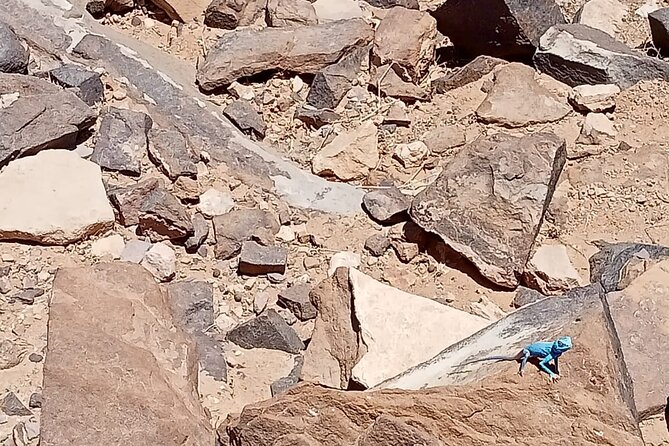
The Nymphaeum is a public fountain beside the Colonnaded Street. Only the foundations remain, shaded by a tree, and the stop lasts about 10 minutes. This is a small detail, but it helps explain the civic life of Petra. The city had public spaces and water features, not only tombs and ceremonial facades.
The Byzantine Church is another brief stop, also around 10 minutes. Its ruins date to the sixth or eighth century according to the supplied information and were not discovered until the 1990s. The building used materials from earlier Nabataean and Roman periods, including pieces connected with windows, doors, and reliefs.
Do not expect a complete church. You will see remains and reused materials. The value is in the later chapter of Petra’s story, when the city continued to change after the Nabataean period.
The order of the listed stops places the church and Nymphaeum among the central Petra sites. Your guide may adjust the exact walking order to fit the route on the day.
Price, group size, and guide quality
The cost is $380 per group for up to six people. For a full group, that works out to about $63 per person, which is reasonable for an 8 to 9 hour private-style outing with pickup offered and a guide accompanying the hike.
For two people, the effective cost is $190 each. For one person, it is the full $380. The value improves sharply as your group grows, so this experience makes the most financial sense for families or friends traveling together.
The small maximum is important. A group of six can move more easily than a large coach party, and you have a better chance to ask questions at Little Petra, the Monastery, and the Treasury. Still, the mixed rating should make you careful about your expectations. One very positive account praised the guide for making the back route and the final Treasury reveal work well. One very negative account said the experience was not worth the time and money, with disappointment about the guiding and historical explanation.
No guide’s name is supplied, so you cannot select a particular guide in advance based on the available information. Ask how much historical commentary is included and confirm the meeting plan before paying. Those two questions could make a real difference on a long day.
Who should choose this hike?
I would choose this for someone who has a full day in Petra and wants more than the standard Treasury photo. It suits you if you enjoy walking through open country, prefer a small group, and like the idea of reaching the major monuments in stages.
It is also a good fit if you have already seen Petra from the main entrance and want a different route. Little Petra, Siq Ghorab, Shamasah, the old village, and the Wadi Araba viewpoint provide experiences that a straightforward entrance walk does not.
I would hesitate if you have limited mobility, dislike steep steps, or want to conserve energy for several days of sightseeing. The 800-plus steps to the Monastery alone are significant, and the total day lasts most of the daylight hours.
The tour requires moderate physical fitness. Service animals are allowed, and the meeting area is near public transportation, but the information does not specify the nature of every trail surface or the availability of transport during the hike. Ask direct questions if you have joint, balance, or stamina concerns.
Free cancellation is available up to 24 hours before the 9:00 a.m. start for a full refund. Changes or cancellations inside that window are not refunded, and poor weather can lead to a different date or a full refund.
Should you book the Petra Back-Road Trail?
Book it if the journey matters as much as the monuments. The back route gives Petra a strong sense of place, the Monastery arrives after a serious mountain walk, and the Treasury becomes a satisfying late-day finish. Those are genuine advantages.
Skip it if you want a short, simple introduction or if $380 is too much for your group size. Also, go in with realistic expectations about guiding. The experience can be excellent when the guide explains the archaeological remains clearly, but the rating spread shows that the service may not feel equally strong every time.
For a group of four to six people who can handle a long hike, I think the value is solid. Confirm admission details, pickup instructions, and the guide’s approach to historical explanation before booking. With those points settled, this is one of the more memorable ways to enter Petra.
FAQ
What time does the Petra back-road hike start?
The tour starts at 9:00 a.m.
Where does the experience begin?
You can arrange pickup, or meet the group at Little Petra, also called Siq al-Barid.
How long does the tour last?
The experience lasts approximately 8 to 9 hours.
How many people can join the group?
The maximum group size is six people.
Is this hike physically demanding?
Yes. A moderate level of physical fitness is recommended, and the approach to the Monastery includes more than 800 steps.
What happens if bad weather cancels the tour?
Because the experience requires good weather, you will be offered another date or a full refund if poor weather causes cancellation.
Just added in Petra
- Private Full-Day Petra Tour with Lunch from the Dead Sea★ 5.0 · 1 review
- Transfer From Dead Sea To Petra★ 5.0 · 4 reviews
- Petra and Wadi Rum Private Guided Tour★ 5.0 · 2 reviews
- Private One Day Petra from Dead Sea with Hotel Pickup★ 5.0 · 6 reviews
- Private Tour: Petra and Wadi Rum Day Trip from Dead Sea★ 5.0 · 1 review
- Petra Excursion from Dead Sea★ 5.0 · 8 reviews
- Petra Private Transfer to or from Dead Sea★ 5.0 · 5 reviews
- Petra Day Tour from Dead Sea★ 5.0 · 6 reviews
Petra Tours, compared.
2-Day Tour: Petra, Wadi Rum, and Dead Sea from Amman
Read our review →

3-Day Private Tour from Amman: Petra, Wadi Rum, Dana, Aqaba, and Dead Sea
Read our review →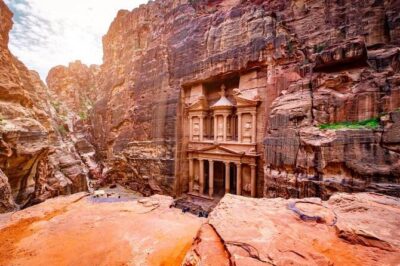
Petra & Wadi Rum: Full Day Private Tour with Hotel Pickup
Read our review →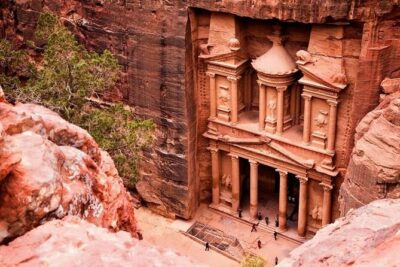
Browse the lists this tour appears in